In Dwarf Fortress, things die. In life, things die. When things die in life, they rot. When things die in Dwarf Fortress, they rot. Things in life, however, do not produce a noxious purple cloud of fog upon death that slowly depresses everyone who inhales it to the point that they are driven mad.
Imagine, if you will, a budding fortress about to enter the peak of its existence. Hardworking dwarves labor in the bowels of the earth to produce beautiful gold crafts and vicious spiked armor alike. All of that wealth, however, attracts unwanted visitors.
A dragon, vicious and red and capable of destroying everything in its path, decided to claim the fortress' wealth for its own. It entered the map, and I sent out my militia. Twenty highly trained dwarves equipped with the finest iron I could produce and equipped with so much armor that I seriously questioned how they were able to move.
Several rounds of combat had reduced the size of my militia by a mere three dwarves, while the dragon suffered from multiple broken bones and a missing eye. Things were looking good. That is, they were until the goblins arrived.
A horde of goblins, thirty of them, all armed with spears and whips appeared at the edge of the map. They quickly discovered that they and the dwarves shared a common enemy, and the dragon was quickly taken care of while the fortress was sealed off.
Unable to access the fortress, the militia immediately turned their backs on the short-lived alliance with the goblin horde and began severing limbs left and right. The battle was long and brutal, destroying both my military and the entire goblin siege. Cautiously, I reopened the fortress and let a torrent of dwarves loose, hungry to get their hands on the unclaimed items of their dead friends and family.
I had established a small refuse pile to hold the corpses in the fortress while I went about building a suitable catacomb to house the bodies of the dead, and it was soon filled to the brim with freshly killed dwarves and goblins. My miners, unfortunately, were far slower than my haulers, and the catacombs were nowhere near complete when they began to rot. Oceans of miasma spewed from the refuse pile and filled my entire fortress.
Within seconds it had reached the meeting hall, generally stinking up the place and making everyone forget how well-made their tables were. The smell was so bad that it made even the happiest of dwarves cry in anguish. It turned the saddest dwarves, those who had lost loved ones in the battle, into bloodthirsty maniacs who began alternating between beating people to death with their own babies and running around babbling.
photo courtesy of df.magmawiki.com
By the end of the month, everyone in the fortress had either gone mad or had been killed.
Dwarves, man. Dwarves.
Sweet Mother of Armok
This is a blog about Dwarf Fortress. It will mostly be concerned with information about updates to the game, as well as tales of my epic adventures in whatever world I generate.
Sunday, May 6, 2012
Friday, April 27, 2012
Minecarts and Horrible Injuries
It's almost time for a new release for Dwarf Fortress!
Are you as excited as I am? I bet you are.
A recent poll of most anticipated changes to Dwarf Fortress has led to the implementation of a drastic mining overhaul. Minecarts, and incredible changes to hauling are the most popular items to be added.
In the past, a dwarf could only carry one item at a time. This meant that moving a pile of seeds or the clothing off of your former mayor's corpse would take dozens of dwarves and intense lag due to the abundance of pathfinding calculations required.
These changes will allow a single dwarf to carry as many items as it can carry, meaning that a single dwarf could now do work that would previously have taken ten! It's amazing. If it doesn't sound amazing then you don't understand how incredibly tedious it can be to watch a small army of dwarves carry single stones back and forth between piles when all you want is a wall constructed.
Minecarts have also been included in the upcoming release, which will allow dwarves to push, pull, load, and even ride minecarts.
the future of DF? (photo courtesy of the minecraft wiki)
Of course, when one thing is added to the game, Toady adds much more to achieve a sense of completion. The implementation of minecarts has led to the addition of damage taken from skidding, parabolic arcs for flying items, and splashing upon hitting water (or magma).
The community is already planning on how to incorporate minecarts into their forts, and plans for cart launching death machines that fling magma-filled minecarts at hordes of goblin spearmen are already underway.
It will be amazing. Just. Amazing.
Are you as excited as I am? I bet you are.
A recent poll of most anticipated changes to Dwarf Fortress has led to the implementation of a drastic mining overhaul. Minecarts, and incredible changes to hauling are the most popular items to be added.
In the past, a dwarf could only carry one item at a time. This meant that moving a pile of seeds or the clothing off of your former mayor's corpse would take dozens of dwarves and intense lag due to the abundance of pathfinding calculations required.
These changes will allow a single dwarf to carry as many items as it can carry, meaning that a single dwarf could now do work that would previously have taken ten! It's amazing. If it doesn't sound amazing then you don't understand how incredibly tedious it can be to watch a small army of dwarves carry single stones back and forth between piles when all you want is a wall constructed.
Minecarts have also been included in the upcoming release, which will allow dwarves to push, pull, load, and even ride minecarts.
the future of DF? (photo courtesy of the minecraft wiki)
Of course, when one thing is added to the game, Toady adds much more to achieve a sense of completion. The implementation of minecarts has led to the addition of damage taken from skidding, parabolic arcs for flying items, and splashing upon hitting water (or magma).
The community is already planning on how to incorporate minecarts into their forts, and plans for cart launching death machines that fling magma-filled minecarts at hordes of goblin spearmen are already underway.
It will be amazing. Just. Amazing.
Wednesday, April 18, 2012
Zombie Weasels and the Collapse of Society
It isn't particularly rare that an experienced player of Dwarf Fortress builds a functioning fortress, in fact, creating a functioning self-sufficient fortress that can repel or avoid attacks and sieges is pretty commonplace. The real "fun" comes from building megaprojects, like giant statues of dwarves rigged to vomit magma on gobilins, or massive towers made out of pure gold that inspire awe in all who see it.
Luckily, I am not good at Dwarf Fortress, so my games become interesting pretty quickly.
Prestigecities, a new dwarven settlement in the white sand desert. Sand deserts promise many things, such as soil for crops, a low chance of having an aquifer, and material for infinite amounts of glasswork.
I have settled in a haunted desert, meaning that the land itself is hostile to life. It is one of the first times I have embarked in such an area, and so I am not quite sure what will happen.
In haunted biomes, it may rain blood or snow ash. Dead bodies will rise up instantly after death and attack their former friends and family with a newfound bloodlust and complete disregard for living beings. Perhaps most terrifying of all, demon fogs have been known to roll through haunted areas, turning all who touch its mist into horrible abominations bent on destruction.
One story in the Bay12 forums tells of a fog that turned its victims into virtually unkillable husks that could turn others simply by touching them. I feared what horrors would await me, and anticipated with glee how I would solve them.
Unfortunately, there were no epic battles. There were no genius traps, and there was no glorious victory over land that refused to be conquered. There wasn't even a farm.
A weasel. A zombie weasel ran onto the map and scared all of my dwarves so bad that they literally ran around in circles until they died of thirst.
Stupid dwarves.
Thursday, March 29, 2012
Of Mad Elves and Madder Dwarves
Behold, from humble beginnings arises the start of a great fortress. Seven dwarves stand on the shores of a great ocean, armed only with two picks, two axes, and a meager amount of food and booze. They must carve a fortress into the earth and sustain themselves for the glory of their kingdom.
The dwarves immediately set out to gain self-sufficiency. Several large rooms are ordered to be dug into the soil just beneath the surface. In time, these rooms will become 400 tiles of pure farm, enough to supply even the largest fortress with food and drink twice over.
The farm starts small, but looks good. A crop of plump helmets, the mushrooms that are the backbone of every dwarven diet, will be ready for harvest in a few short weeks.
Meanwhile, the miners dig a 3x3 staircase deep into the stone, hoping to find valuable resources to build the fortress. Eventually, iron is discovered. Glorious, glorious iron. Iron means swords and armor and traps, the three things that are absolutely necessary for a fortress to survive a goblin siege or ambush.
After basic industries are set up, construction begins on a trap-filled entrance to the fortress. Stone is hauled from deep underground and formed into a large structure. Halls will soon be constructed and filled with traps, and a drawbridge will be installed to block off the fortress in the event of attack.
Elven traders come to the fortress, bearing exotic animals and fine cloth. The elves are a fickle bunch, refusing all products at all related to wood. The dwarves are uneasy, but welcome trade.
Goblins attack! A small ambush of five, perhaps six goblin warriors spring out of nowhere and attack the fortress. The drawbridge is raised as the dwarves hurry to complete the trap-hall. Six goblins is not a threat to a thriving, powerful fortress, but this one is weak. Its army has yet to be established due to the slowness of the metal industry, and there are no traps to defend from invaders.
Tragedy strikes! A wave of migrants, hopeful new immigrants to the fortress, enter the map and attempt to enter. The drawbridge cannot be lowered, the goblins cannot be allowed inside. The migrants die outside, slain one by one by the small band of goblins.
Eventually, the goblins grow bored and leave, but the damage is done. The elven traders trapped inside the fortress have gone mad, likely from the high amounts of testosterone and badassery contained within every dwarf fortress, and their horses have kicked in the skulls of three incredibly social dwarves. Everyone takes their deaths hard, some harder than most. A particularly strong dwarf throws a tantrum, and punches his wife's skull in. Her death drives more people into a blind rage, and eventually the entire fortress is reduced to a screaming crying pile of blood and tears and broken bone.
Typical.
Wednesday, March 21, 2012
Concerning Dwarves
Dwarf Fortress is not only a game of wild adventure and beating people to death with the skulls of elf children. Dwarf Fortress also contains Fortress Mode, wherein the player controls a band of dwarves as they try to raise up a fortress in the wilderness.
If Adventure Mode's complexity can confuse a new player, then Fortress Mode will make them tear out their hair, pluck out their eyes, and use them to strangle their entire family.
The user interface is... lacking, to put it nicely. A complete absence of tutorials makes it difficult for a new player to learn how to play without help, and the complex and seemingly random button-assignments can make remembering controls a task for even the most experienced players.
For example, in order to build a wall one must hit b followed by C followed by w and then k and h or u and m depending on how wide or tall or short or thin you want your wall to be.
Some controls are somewhat easier, and the players have hints to help them recall what each button.
If I want to build a carpenter's workshop, then I want to hit (b)uild, (w)orkshops, (c)arpenter. Building a magma forge requires (b)uild, (v)vvforge, (m)agma.
It's weird. It's Dwarf Fortress. Don't question it.
Further posts in this blog will deal with Fortress mode and the way that the new release has influenced how it is played.
In the meantime, there are several examples of early forts that have shaped the history of the Dwarf Fortress fanbase.
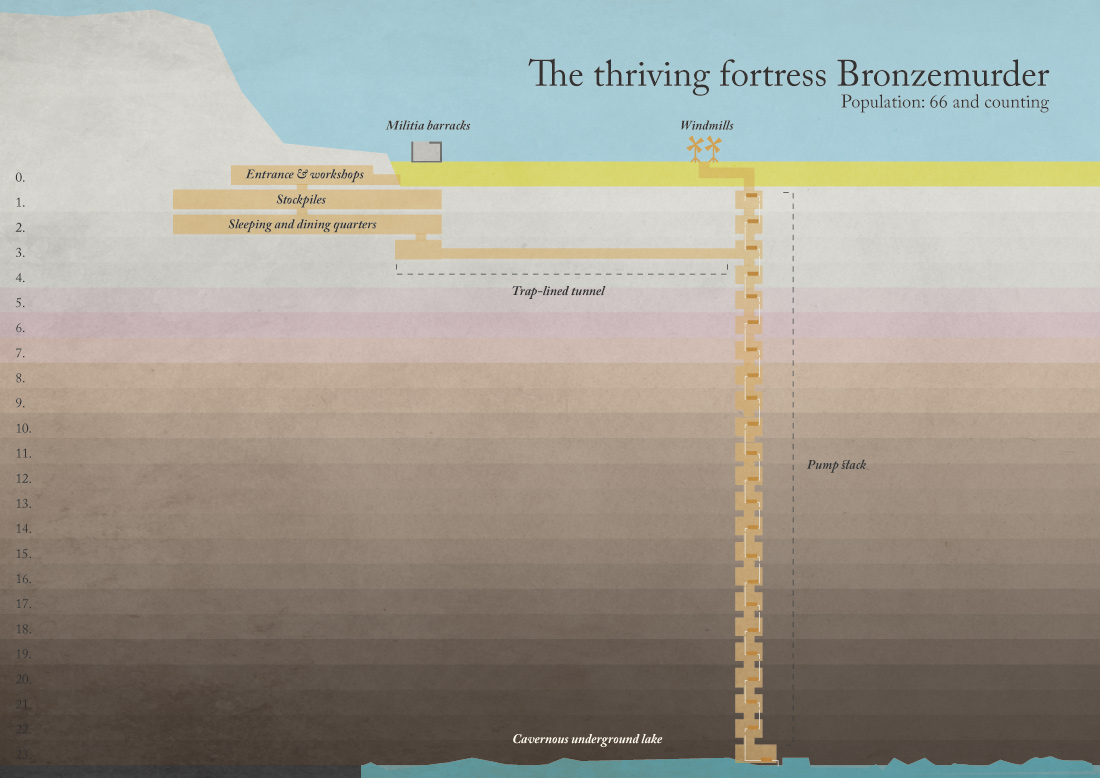
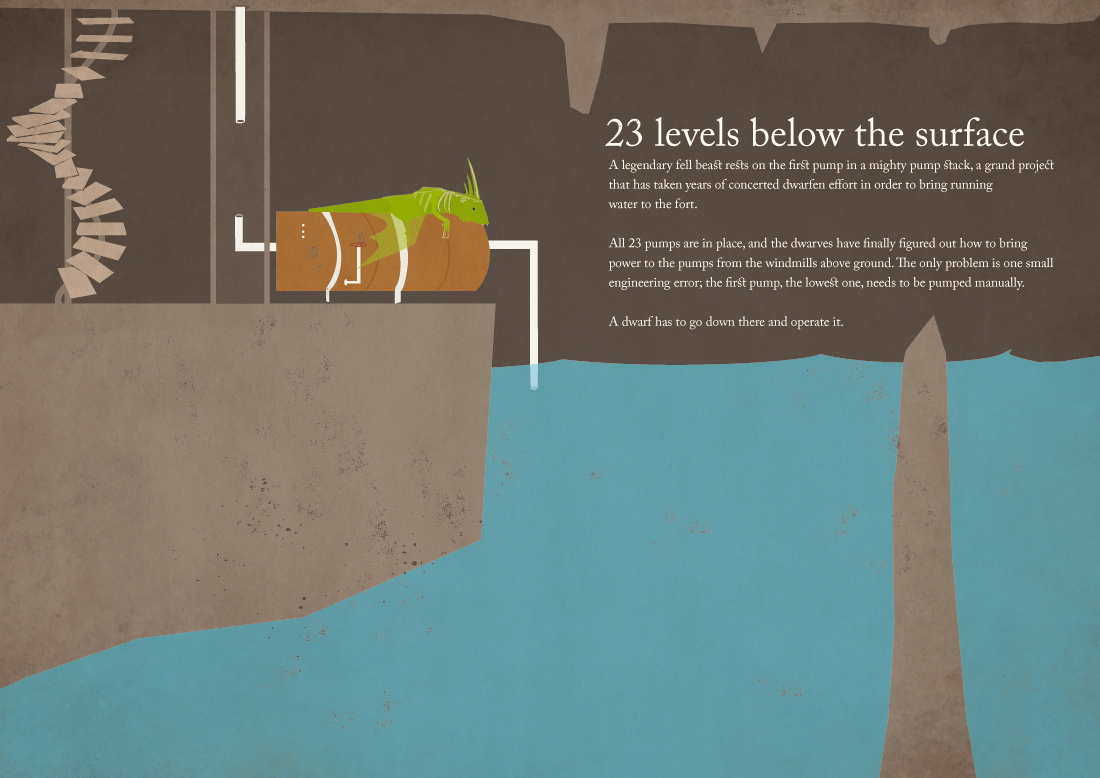
Bronzemurdered
and the famed Boatmurdered
(it should be noted that I am not the creator of either of these fortresses, and that I do not in any way take credit for the magic they bring to the world)
Both are a bit old, having been made when earlier versions of Dwarf Fortress were the only options available (Boatmurdered is especially dated, having been created prior to the introduction of the z-axis in Fortress Mode), but are fantastic examples of what makes Dwarf Fortress so... fun.
Here's a few excerpts from Bronzemurdered.
For example, in order to build a wall one must hit b followed by C followed by w and then k and h or u and m depending on how wide or tall or short or thin you want your wall to be.
Some controls are somewhat easier, and the players have hints to help them recall what each button.
If I want to build a carpenter's workshop, then I want to hit (b)uild, (w)orkshops, (c)arpenter. Building a magma forge requires (b)uild, (v)vvforge, (m)agma.
It's weird. It's Dwarf Fortress. Don't question it.
Further posts in this blog will deal with Fortress mode and the way that the new release has influenced how it is played.
In the meantime, there are several examples of early forts that have shaped the history of the Dwarf Fortress fanbase.
Bronzemurdered
and the famed Boatmurdered
(it should be noted that I am not the creator of either of these fortresses, and that I do not in any way take credit for the magic they bring to the world)
Both are a bit old, having been made when earlier versions of Dwarf Fortress were the only options available (Boatmurdered is especially dated, having been created prior to the introduction of the z-axis in Fortress Mode), but are fantastic examples of what makes Dwarf Fortress so... fun.
Here's a few excerpts from Bronzemurdered.
Ooh, spooky. I wonder what happens next? (EVERYONE IS MURDERED. JUST. JUST EVERYONE.)
Thursday, February 23, 2012
Wherein Jake Talks About Modding
Toady is continuing his work on bug fixing, and has already made significant progress. He's fixed several particularly heinous bugs, including one that causes the game to crash if you try to talk to someone, and one that makes it so vampire dwarves don't disguise themselves when they try to move into your fortress.
Now that bug fixing is making progress, I can start talking about modding.
Dwarf Fortress, like many modern video games, makes its code available for modifications by the players. Dwarf Fortress has two aspects of its code. The "hard coding" and the "raws".
The hard coded parts of the game deal with the basics of Dwarf Fortress, such as "water flows" and "the moon exists". Raws deal with the more fluid parts of the game such as "rocks don't explode" and "blood isn't a solid", and are easily modified by the players.
This post will focus on modification of the raws, as only Toady really has the ability to modifiy the code in any way that makes sense.
Using the Genesis Mod, I created a minotaur adventurer and visited an orc town.
In the Dwarf Fortress modification community, there is arguably no one better than the forum user Deon. He is most popular for creating the Genesis Mod, which adds dozens of new monsters, creatures, plants, races, and interactions to the game. He used the raws to add new castes and subraces to the Dwarven people, and has added potion brewing, powerful magic, and alchemy to both Fortress Mode and Adventure Mode.
The new release introduces several new tags, which modify creature and item behavior, such as NOT_LIVING and OPPOSED_TO_LIFE, which tells the game that a creature isn't alive and actively wants to destroy living things.
Interactions have also been added in addition to the reactions that were the standard of previous versions. Reactions essentially allow an adventurer or a fortress citizen to create items using other items, or (through modification of the raw files) to create items out of nothing. Interactions, however, are the first true taste of magic in the game.
As of yet, only three interactions are featured in the game. One allows necromancers to raise the dead as walking corpses, another allows dragons to breathe fire, and another allows spiders to spin webs. Modification of the raws allows for interactions to do much, much more.
My minotaur adventurer being mauled by a crapload of bogeymen
Interactions are made available to characters via syndromes, which have been updated since the last release. Syndromes are no longer used for making people vomit blood or ooze pus, but can now be used to make people capable of performing interactions.
Combining syndromes and interactions allows for adventurers to read the secrets of life and death in order to gain necromancer powers, and syndromes like lycanthropy and vampirism can be spread through bites and blood.
These new features are very good for Dwarf Fortress' thriving modding community, and many people (including myself) are looking forward to seeing what gets thought up.
Now that bug fixing is making progress, I can start talking about modding.
Dwarf Fortress, like many modern video games, makes its code available for modifications by the players. Dwarf Fortress has two aspects of its code. The "hard coding" and the "raws".
The hard coded parts of the game deal with the basics of Dwarf Fortress, such as "water flows" and "the moon exists". Raws deal with the more fluid parts of the game such as "rocks don't explode" and "blood isn't a solid", and are easily modified by the players.
This post will focus on modification of the raws, as only Toady really has the ability to modifiy the code in any way that makes sense.
Using the Genesis Mod, I created a minotaur adventurer and visited an orc town.
In the Dwarf Fortress modification community, there is arguably no one better than the forum user Deon. He is most popular for creating the Genesis Mod, which adds dozens of new monsters, creatures, plants, races, and interactions to the game. He used the raws to add new castes and subraces to the Dwarven people, and has added potion brewing, powerful magic, and alchemy to both Fortress Mode and Adventure Mode.
The new release introduces several new tags, which modify creature and item behavior, such as NOT_LIVING and OPPOSED_TO_LIFE, which tells the game that a creature isn't alive and actively wants to destroy living things.
Interactions have also been added in addition to the reactions that were the standard of previous versions. Reactions essentially allow an adventurer or a fortress citizen to create items using other items, or (through modification of the raw files) to create items out of nothing. Interactions, however, are the first true taste of magic in the game.
As of yet, only three interactions are featured in the game. One allows necromancers to raise the dead as walking corpses, another allows dragons to breathe fire, and another allows spiders to spin webs. Modification of the raws allows for interactions to do much, much more.
My minotaur adventurer being mauled by a crapload of bogeymen
Interactions are made available to characters via syndromes, which have been updated since the last release. Syndromes are no longer used for making people vomit blood or ooze pus, but can now be used to make people capable of performing interactions.
Combining syndromes and interactions allows for adventurers to read the secrets of life and death in order to gain necromancer powers, and syndromes like lycanthropy and vampirism can be spread through bites and blood.
These new features are very good for Dwarf Fortress' thriving modding community, and many people (including myself) are looking forward to seeing what gets thought up.
Wednesday, February 15, 2012
Wherein Jake Gets Overexcited About Dwarves
Toady finally released version 0.34.01 of Dwarf Fortress! There's some pretty serious bugs that have to be addressed in the coming weeks, but I managed to generate a passable world. I'll be using the Phoebus tile set, which generally makes the game easier to understand by replacing the ASCII characters with little pictures of trees and dogs and demons and whatnot.
I'll be playing as Rorik Ironbutter, a proficient swordsman wielding quite possibly the worst weapon in the entire game: a copper two handed sword that can neither cut through armor nor be wielded properly while using a shield. A recipe for fun indeed.
I talked to a weaponsmith about any goings-on in the area surrounding the city. He pointed me in the direction of a dark and mysterious tower, instructing me to slay Xidel Eyescorched, the necromancer that lives there. Being the brave adventurer I am, I accepted.
After consulting my map, I plotted a course for the tower and set out. I had minimal food, minimal water, and no one to protect me from the horrible abominations that stalk the night. At last, I approached the tower, eager to sink my blade into the flesh of the undead.
Oh. Armok. No. I counted five necromancers and easily twice as many shambling corpses within the first floor of the tower. I tried to make a hasty retreat, hoping they hadn't spotted me, but I was far too late. Faced with no other recourse, I gripped my sword and charged into battle.
My first hit is a lucky one, severing one of the necromancer's tendons. His arm will be nearly useless for the remainder of this battle.
I retreated quickly out of the tower to reduce the chances of being cornered. Another blow to the necromancer slices open one of his arteries and causes him to drop his weapon.
His blood gushes out of the wound in his arm, quickly leaving his body empty. It slumps to the ground, pale and lifeless, before standing up again under the power of a different necromancer. It groans an unearthly groan and moves toward me.
A quick blow with my sword sends the abomination stumbling backward, giving me time to focus my attack on a different necromancer. After a few minor cuts and bruises, she begins fleeing for her life.
The fool. She thought that she could escape death by practicing unholy magics and making covenants with demons, but all the magic in the world couldn't save her from my sword. Her intestines spill to the ground, and I move my focus to another foe. The necromancer is no concern of mine any longer, death will find her soon enough.
The next necromancer's left arm is shattered by a powerful blow of my sword. Copper may not be strong enough to sever limbs, but the force of the strike leaves him wracked with pain. He passes out, unable to handle it, and I slash his head apart at my leisure. Three down. Two to go.
Running? Oh, you poor things. Haven't you learned that running from Rorik Ironbutter can only end in a slow and painful death?
I finally catch up to the fleeing necromancer, and stab him in the back. He attempts to attack me, but his efforts are fruitless.
With my sword embedded in his back, I am left with no other option than to punch the necromancer in the back of the head. The intensity of the battle has given me superhuman strength, it would seem, for I easily crush his skull and destroy his brain. He falls to the ground and I remove my sword, just in time for the final necromancer to raise him as a walking corpse.
The battle with the final necromancer is short. Fearful for his life, he makes several mistakes, allowing me to sever the motor nerves of both his feet. He falls to the ground, unable to move, and I slice open his belly and leave him to die.
With the necromancers dead, all that remains is to clear the landscape of their unholy work. My muscles ache and my bones grow weary. I am covered in cuts and bruises and I have seen more death today than most will witness in a lifetime. I couldn't be happier.
Oh, Rorik. You got dark.
EDIT: Rorik was later eaten by wolves.
I'll be playing as Rorik Ironbutter, a proficient swordsman wielding quite possibly the worst weapon in the entire game: a copper two handed sword that can neither cut through armor nor be wielded properly while using a shield. A recipe for fun indeed.
I talked to a weaponsmith about any goings-on in the area surrounding the city. He pointed me in the direction of a dark and mysterious tower, instructing me to slay Xidel Eyescorched, the necromancer that lives there. Being the brave adventurer I am, I accepted.
After consulting my map, I plotted a course for the tower and set out. I had minimal food, minimal water, and no one to protect me from the horrible abominations that stalk the night. At last, I approached the tower, eager to sink my blade into the flesh of the undead.
Oh. Armok. No. I counted five necromancers and easily twice as many shambling corpses within the first floor of the tower. I tried to make a hasty retreat, hoping they hadn't spotted me, but I was far too late. Faced with no other recourse, I gripped my sword and charged into battle.
My first hit is a lucky one, severing one of the necromancer's tendons. His arm will be nearly useless for the remainder of this battle.
I retreated quickly out of the tower to reduce the chances of being cornered. Another blow to the necromancer slices open one of his arteries and causes him to drop his weapon.
His blood gushes out of the wound in his arm, quickly leaving his body empty. It slumps to the ground, pale and lifeless, before standing up again under the power of a different necromancer. It groans an unearthly groan and moves toward me.
A quick blow with my sword sends the abomination stumbling backward, giving me time to focus my attack on a different necromancer. After a few minor cuts and bruises, she begins fleeing for her life.
The fool. She thought that she could escape death by practicing unholy magics and making covenants with demons, but all the magic in the world couldn't save her from my sword. Her intestines spill to the ground, and I move my focus to another foe. The necromancer is no concern of mine any longer, death will find her soon enough.
The next necromancer's left arm is shattered by a powerful blow of my sword. Copper may not be strong enough to sever limbs, but the force of the strike leaves him wracked with pain. He passes out, unable to handle it, and I slash his head apart at my leisure. Three down. Two to go.
Running? Oh, you poor things. Haven't you learned that running from Rorik Ironbutter can only end in a slow and painful death?
I finally catch up to the fleeing necromancer, and stab him in the back. He attempts to attack me, but his efforts are fruitless.
With my sword embedded in his back, I am left with no other option than to punch the necromancer in the back of the head. The intensity of the battle has given me superhuman strength, it would seem, for I easily crush his skull and destroy his brain. He falls to the ground and I remove my sword, just in time for the final necromancer to raise him as a walking corpse.
The battle with the final necromancer is short. Fearful for his life, he makes several mistakes, allowing me to sever the motor nerves of both his feet. He falls to the ground, unable to move, and I slice open his belly and leave him to die.
With the necromancers dead, all that remains is to clear the landscape of their unholy work. My muscles ache and my bones grow weary. I am covered in cuts and bruises and I have seen more death today than most will witness in a lifetime. I couldn't be happier.
Oh, Rorik. You got dark.
EDIT: Rorik was later eaten by wolves.
Subscribe to:
Posts (Atom)